

-
Via Agrippa in Hürth
-
-
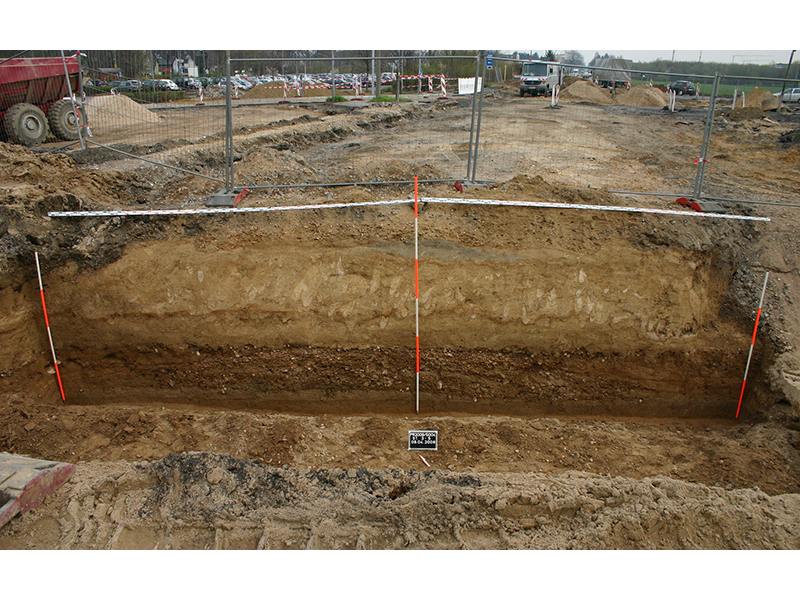
SWhether due to their solid construction, the direct connections between locations, or simply out of habit, some Roman roads continued to be used throughout the Middle Ages and into modern times. On the other hand, the Romans sometimes built their roads on existing prehistoric natural paths. Between “Barbarossaplatz” square in Cologne and the youth hostel in Hürth-Hermülheim, today's road “Luxemburger Strasse” runs for eight kilometres exactly on top of the ancient straight-as-an-arrow long-distance road. A cross-section through “Luxemburger Strasse” in the area of the roundabout shows the continuous use of a Roman road.
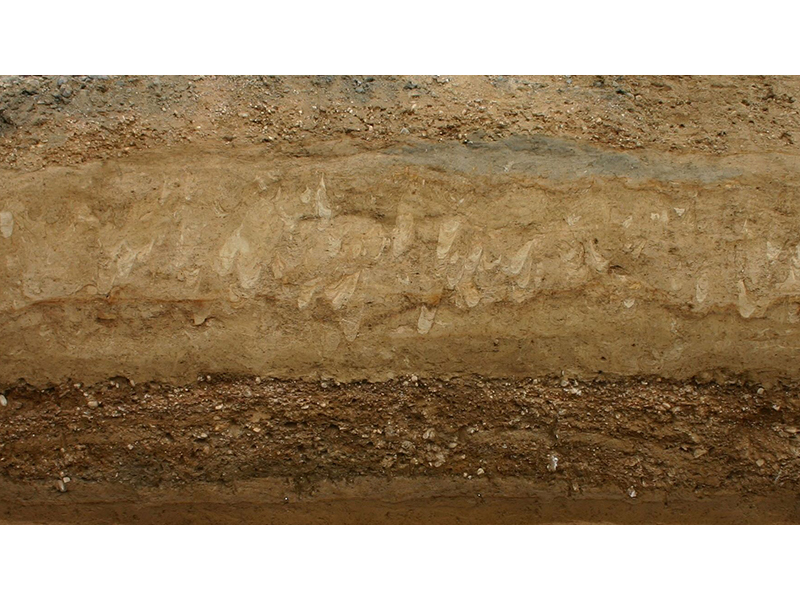
n total, the superimposed roads from different periods uncovered in the excavation section form a layer package of almost 2.5 metres. The Via Agrippa, uncovered at a depth of approx. 2.2 metres, had the typical semi-lenticular structure of Roman roads made of gravel and was 4.2 metres wide and 0.5 metres high. Above it were further layers of gravel resulting from the constant renewal of the road surface. Cart tracks can be seen on the upper edge of the flat gravel surface.
The fill above the Roman road comes from the medieval to modern reuse of the road. Deeply dug-in wheel tracks are also clearly visible here. Immediately below the current asphalt surface is the Prussian cobblestone pavement.
Underneath Via Agrippa, there is a grey layer of clay approximately the width of the Roman long-distance road, in which prehistoric shards have been found: possibly an indication that a road already ran along here in pre-Roman times.