-
Late Roman burgus villa
-
-
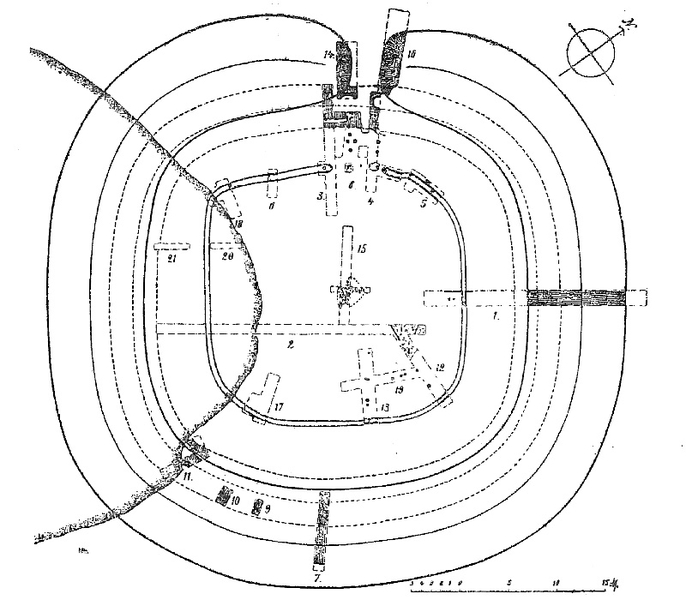
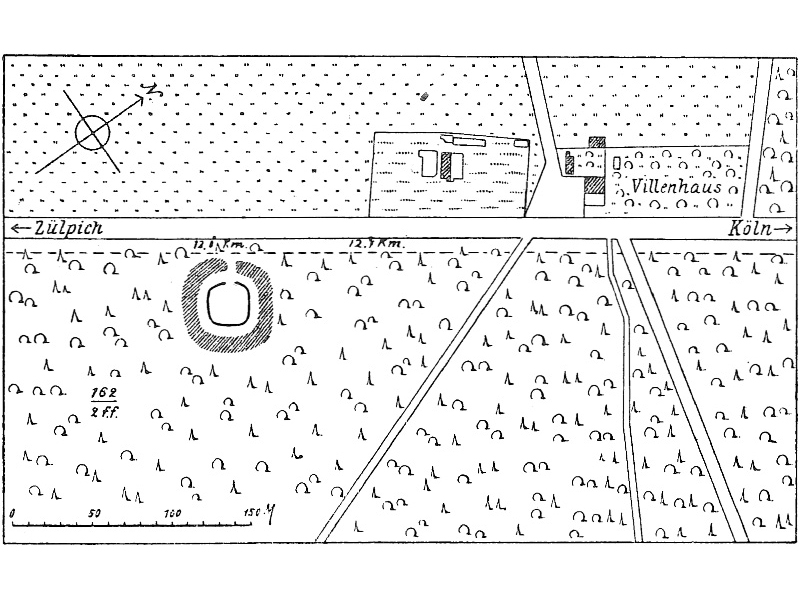
Right next to Via Agrippa, near the former villa, a former forester's lodge, there was a Roman fortification, a so-called burgus. The Roman road post fell victim to lignite mining in the 1920s. Before that, however, it was examined by the then Provincial Museum in Bonn.
The fort was built in the 3rd century AD. At that time, Germanic tribes were increasingly threatening the border on the Rhine. The construction site was strategically chosen, as it was located on the highest point of the foothills, the so-called "Ville". The inhabitants could see Cologne on one side and Zülpich on the other.
Towards the end of the 3rd century, the fortification fell victim to a fire, but was later rebuilt. During the expansion phase in the 4th century, it had a square floor plan with strongly rounded corners and a side length of 60 metres. For defence purposes, the Romans dug a ten-metre-wide and 3.5-metre-deep pointed ditch. They used the earth from the ditch to build a five-metre-wide rampart on the inside. In the north-west, facing the road, there was an entrance that was apparently secured with a wooden gate. Traces of construction were found inside the fortification. Presumably, there was a tower-like building here.
A comparable structure was the Heidenburg (near Bergheim), which was located in a similarly favourable position on the promontory on the Via Belgica. Such structures were built at regular intervals along the Via Belgica, the Via Agrippa and the Limes Road as part of the defence of the hinterland and the most important transport links.
Around 200 metres east of the fortification near Villenhaus, archaeologists have found one of the few milestones of the Via Agrippa. According to the inscription, the stone was erected during the reign of the Roman emperors Trebonianus Gallus and Volusianus between 251 and 253 AD.