

-
Via Agrippa in Erftstadt
-
-
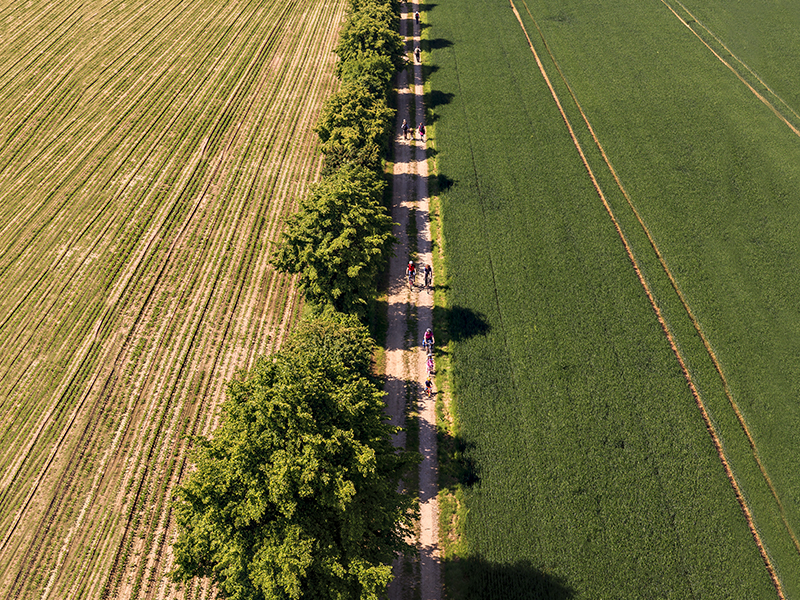
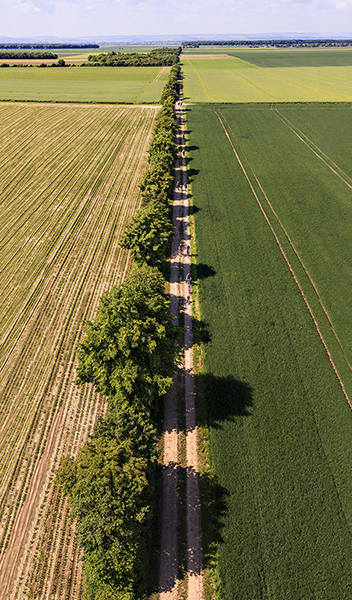
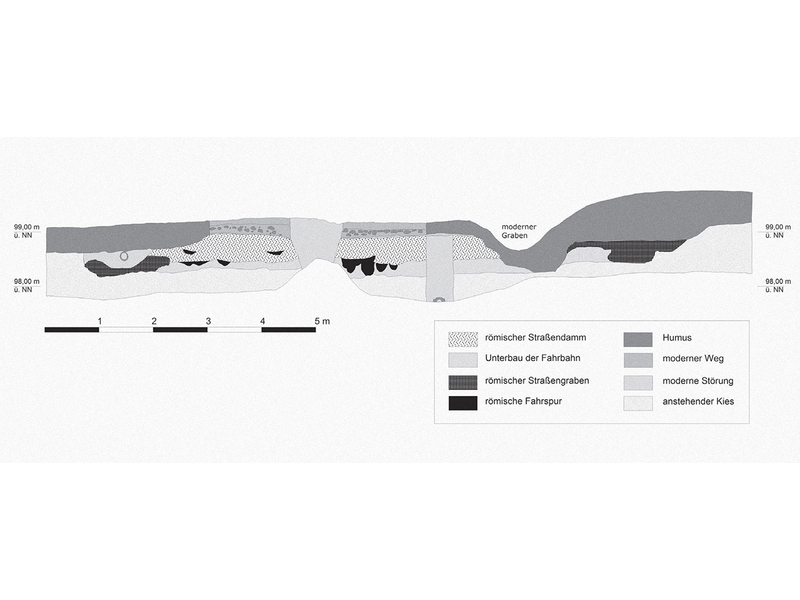
Today, you can still follow the Agrippa Road between Cologne and Zülpich for almost 35 kilometres. With a few interruptions, the course of modern roads and field paths corresponds to that of the Roman long-distance road. This is also the case here, near the Römerhof stud farm, where a small-scale profile section was created in 2004 for archaeological investigation of the road.
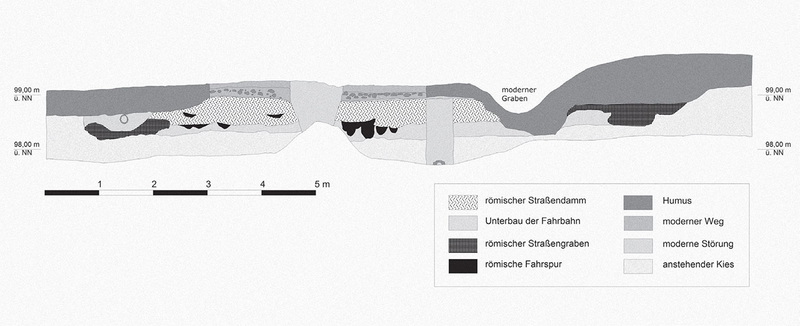
Remains of the Roman road structure lie just 30 centimetres below today’s dirt track. The road structure is 8.30 metres wide. The dating of two ditches located on either side is unclear. As the road has remained in use throughout the centuries, this could also be assumed for the ditches. In this case, the road would have a total width of 11.40 metres, including the ditches. It is possible that one or two unpaved tracks, known as summer paths, were laid out alongside the carriageway and ditches, as it was the case elsewhere.
To construct the road, the Roman engineers first removed the topsoil and an additional ten centimetres of the underlying gravel layer. Three layers of clayey loam applied to this level formed the substructure of the carriageway. Numerous cart tracks cut into it prove that the route was used by carts during the construction period. The road surface above consists of dense gravel and is still preserved to a height of up to 22 centimetres. The two-layer structure of the road is clearly visible in the profile section.