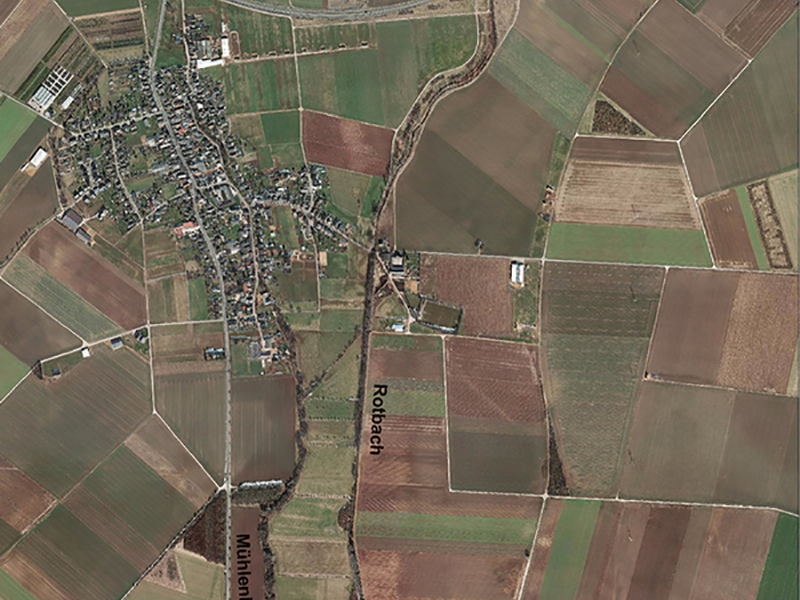
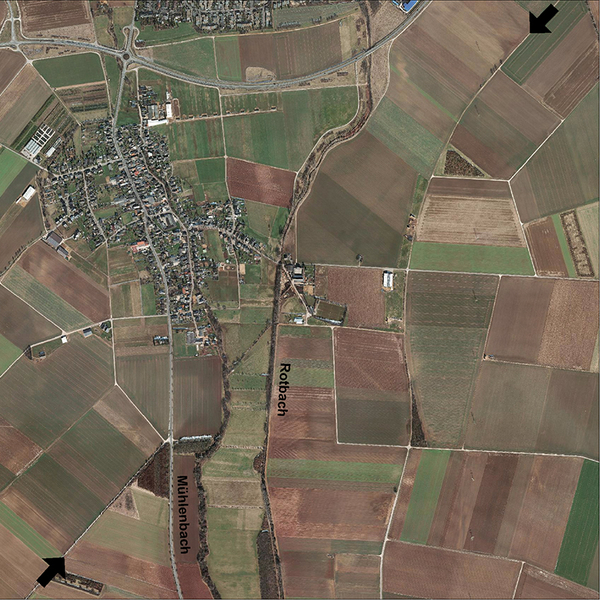
Twelve cremation graves from the 2nd and 3rd centuries AD were found at the edge of Agrippa Road during an archaeological excavation. This suggests that there was a farmstead (villa rustica) or other Roman settlement nearby. However, this has not yet been located, but it may be further east near the Rotbach stream. There are many examples of Roman settlements being founded at river crossings. Clay often deposits at the edge of bodies of water, providing ideal conditions for pottery production.
The production of ceramics in this region is evidenced by a pottery kiln found near the cremation burial places, and geophysical measurements on the west bank of the Mühlengraben revealed the locations of further kilns. Another pottery workshop was found further upstream near Friesheim.
The Lechenicher Mühlengraben once powered several water mills. A continuous water supply was important for this, so water was diverted from the Rotbach stream with the aid of a weir. The former town mill (Oebelsmühle) of Lechenich is also located on the Lechenicher Mühlengraben (mill ditch). The mill, which once belonged to the Archbishop of Cologne, was first mentioned around 1293 and functioned as a ban mill for a long time.