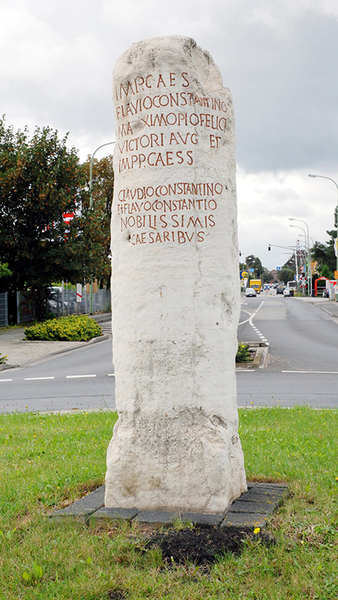
Another, incompletely erased inscription is dedicated to Emperor Licinius, who ruled alongside Emperor Constantine from 308 to 324 AD. After Licinius fell from grace, the stone was re-inscribed, this time with a dedication to Emperor Constantine and his sons. There is a noticeable gap in this text: it contained the name of the eldest son of the emperor, Caesar Crispus. After he fell victim to political intrigue and was executed, all memory of him was to be erased. Therefore, his name was also removed from the inscription.
The stone is considered a prime example of how even smaller towns in the Roman provinces took part in high politics and reacted immediately to new developments. It was discovered during excavation work in the 1960s on the road “Nideggener Straße” (Via Agrippa Cologne–Trier) in the Zülpich district of Hoven.
Strictly speaking, the milestone is a league stone: it indicated the distance from Tolbiacum (Zülpich) to Colonia Agrippinensis (Cologne) as 16 leagues, a Celtic unit of length commonly used in the region at that time. One league corresponds to 2,200 metres, so the distance to Cologne was around 35 kilometres.