-
St. Peter's Chapel (Charles' Chapel)
-
-
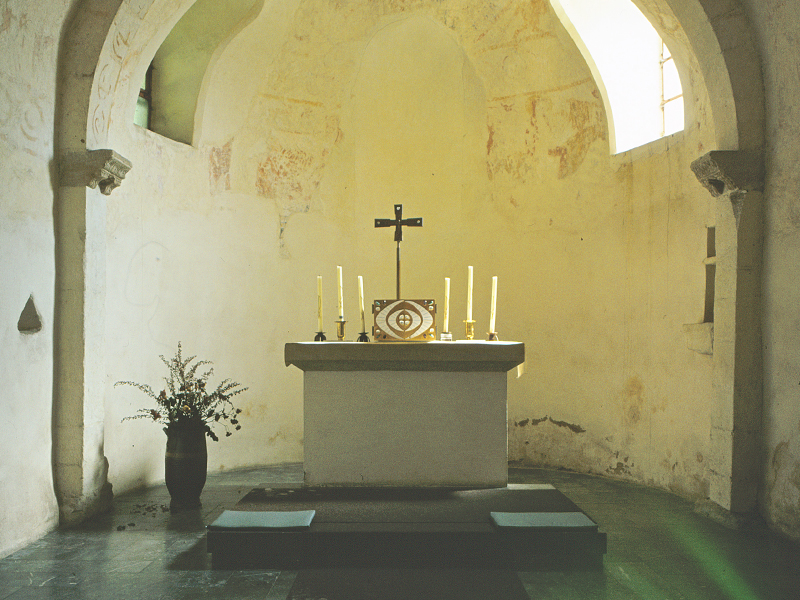
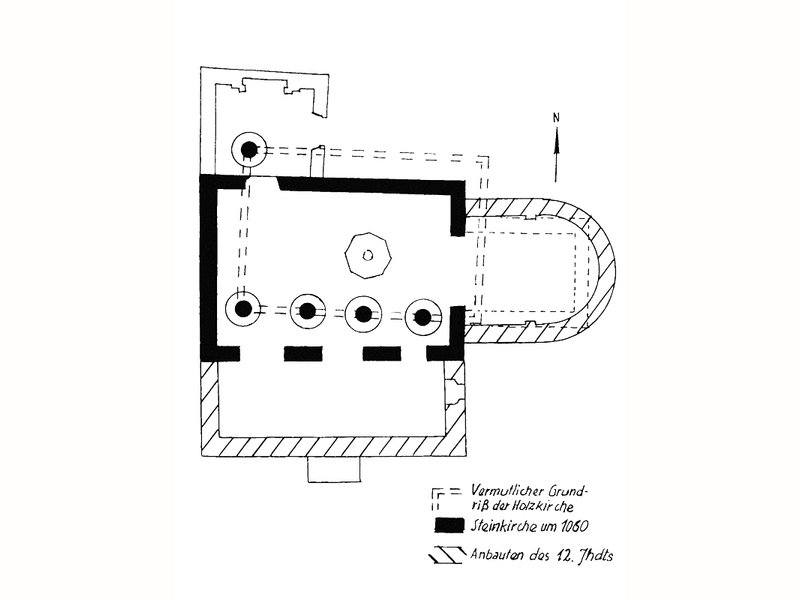
It is considered one of the most important early churches in the Rhineland. In addition, St. Peter's Chapel – also known locally as Charles’ Chapel – is the most important landmark in Übach-Palenberg. The chapel bears the name of Charlemagne. Experts suspect that it may have been a hunting chapel for the emperor, who lived in nearby Aachen. On the one hand, it has been proven that a burial ground with a wooden post church existed at the current location of the Charles’s Chapel from the 7th century onwards. On the other hand, the church faces east – just like Aachen Cathedral.
The oldest part of the chapel dates back to the 11th century. The masonry consists of various building materials from almost a thousand years: field stones, river pebbles, quarry stones, Roman brick fragments, medieval bricks, cement plaster and modern repair mortar.
The nave of the chapel is nine metres long and six metres wide inside, and its windows are bricked up in the south and north walls. In the 12th century, it was extended by a south aisle. On the initiative of church master Hermann von Mirbach, the north porch was added to the inner north wall between 1650 and 1653. The current west and south gables were covered with bricks, and the roof structure was also modified accordingly.
During the uncertain times of the 17th century (including the Thirty Years' War), these extensions served as accommodation for guards and provided a view over the open Wurm valley. Next to the chapel is a cemetery where several old grave crosses made of sandstone and Namur bluestone can still be seen.