-
Roman city gate
St. Aposteln
-
-
St. Aposteln
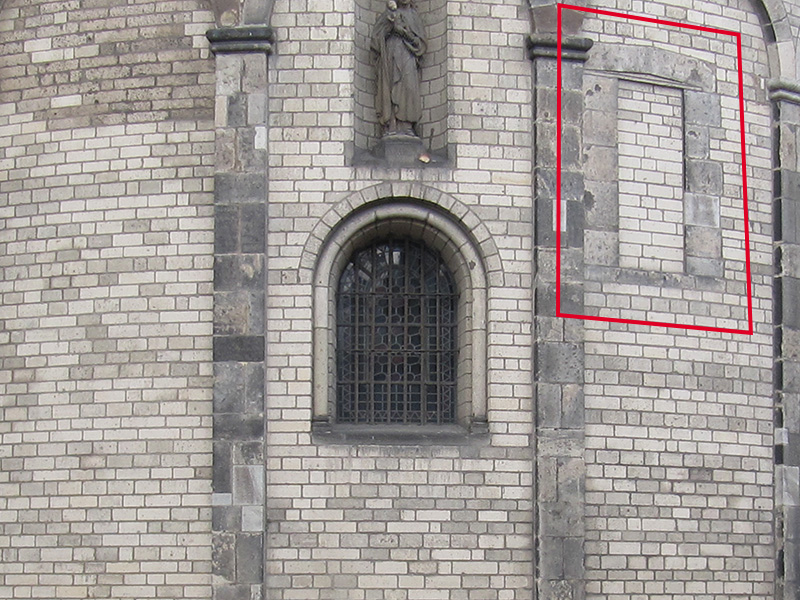
The Roman state road from Cologne to the Atlantic coast begins at the central western gate of the Roman city wall. The imposing structure consisted of a gatehouse with three passageways and two towers. Light-coloured stones in the paving of the square in front of the east choir of St. Aposteln Church mark its location. A walled gate at a height of 7.80 metres in the choir apse originally led to the walkway of the Roman city wall, which was still preserved here in the 12th century.
From the second half of the 1st century AD, a planned suburb (suburbium) lay in front of the Roman city wall on the Via Belgica. This was followed by cemeteries on both sides of the long-distance road for a distance of about two kilometres.
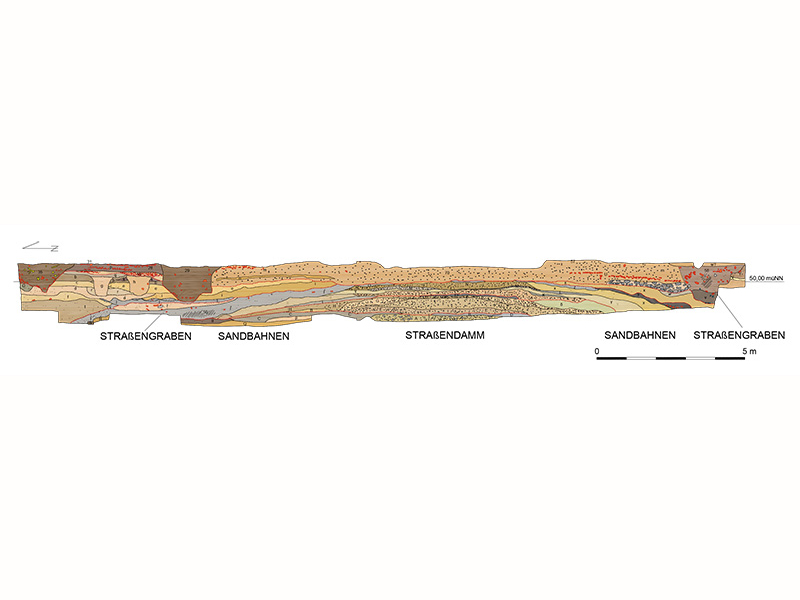
In the Middle Ages, the section of the Roman road between Neumarkt square and Rudolfplatz square became part of the agricultural land belonging to the Apostelstift monastery. In this section, the road lost its function and was abandoned. In 2008, the Via Belgica was excavated here during an archaeological investigation. A preserved cross-section of the road structure with the accompanying sand paths and drainage ditches is on display in the foyer of the Fritz Thyssen Foundation in the former “Amerika Haus” (America House) (Apostelnkloster 13–15).
A church dedicated to the twelve apostles is first mentioned in written sources in 965. The basilica acquired its present form with a west tower and triconch apse in the 12th century.