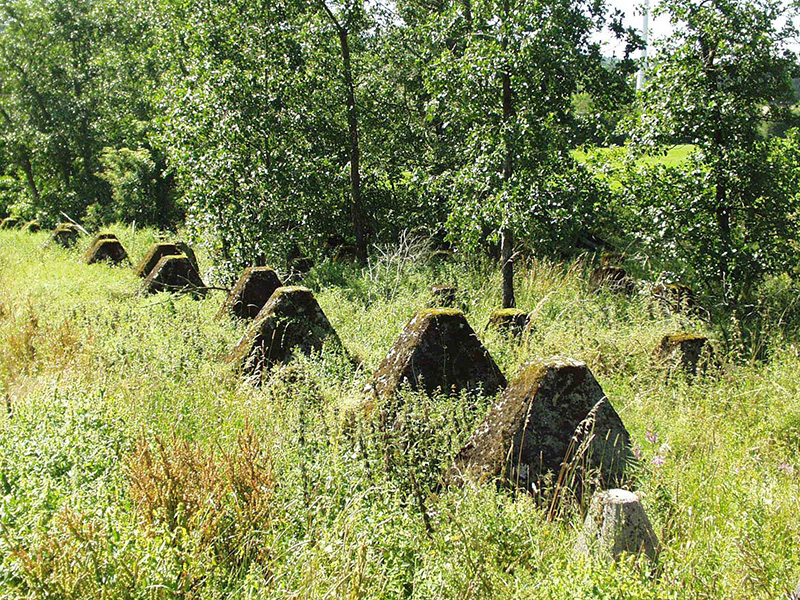
Built between 1936 and 1939, the 630-kilometre-long Siegfried Line was intended to prevent foreign troops from advancing into German territory. 450,000 people were involved in constructing the fortifications, which were referred to by the Allies as the "Siegfried Line". It stretched from Kleve on the Dutch border to Grenzach-Wyhlen on the Swiss border. At a cost of 3.5 billion Reichsmarks, eight million tonnes of cement and 1.2 million tonnes of iron were used. Over 18,000 bunkers, tunnels, trenches and tank barriers were built.
The plan was to stop enemy tanks with a tank barrier made of concrete blocks four to six metres wide and one to one and a half metres high. The soldiers in the bunkers were to fight the enemy with machine gun fire and anti-tank guns. However, when war broke out, the Siegfried Line was only partially complete. As a result, it had little influence on the course of the war.
Parallel to the Siegfried Line, the air force built the Western Air Defence Zone (LVZ). It was to consist of 60 anti-aircraft batteries and run from Jülich to Speyer. In the Dahlemer Binz area, an LVZ facility consisting of cable wells for the telephone network, water bunkers and a former anti-aircraft gun emplacement has been preserved. Anti-aircraft fire was intended to combat enemy air formations and force them to climb. As the consumption of aviation fuel increases during climb, the operational radius of the aircraft would be limited – at least that was the plan. The tank barrier made of concrete humps west of the municipality of Dahlem near the Belgian border is almost completely preserved. Only parts of the bunker line can be seen today, as many sections of the fortress were blown up and removed after the Second World War. The tank barrier and bunker line are part of the Siegfried Line.