

-
Vicus Baesweiler
-
-
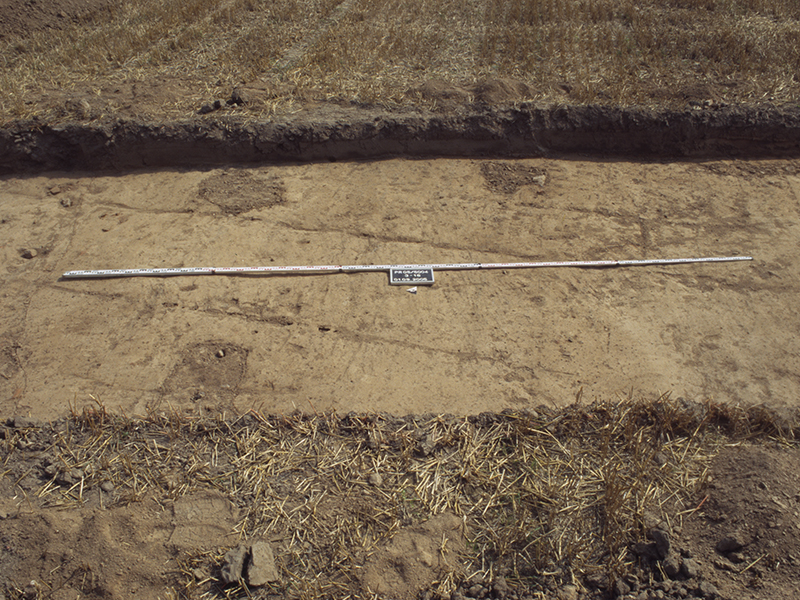
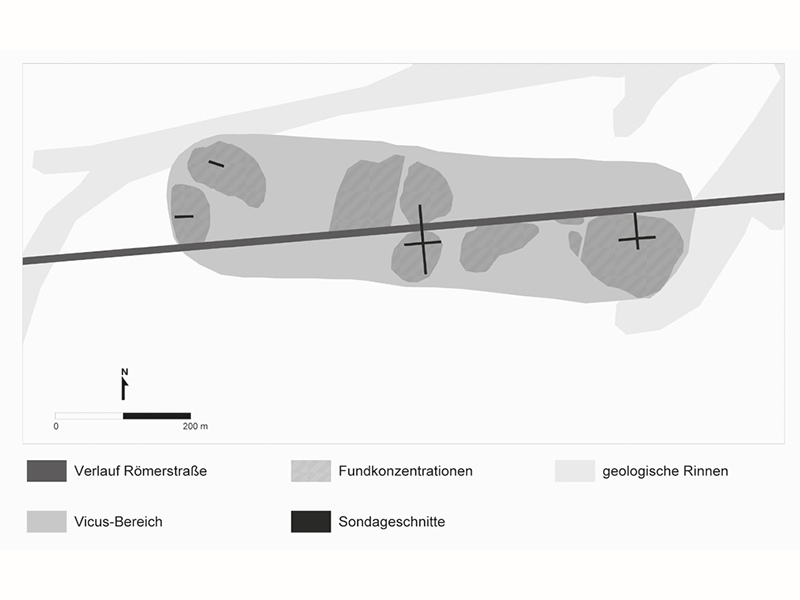
Here at the foot of Carl Alexander Park, you can now look out over a vast agricultural landscape. In Roman times, however, when the slag heap did not yet exist, the Via Belgica crossed an extensive settlement in an east-west direction over a length of 850 metres. It was founded as early as the 1st century AD and covered an area of approximately 17 hectares. Its Roman name is unknown.
The settlement consisted of groups of half-timbered buildings spread out on both sides of the Roman highway and – unlike other vici – not directly adjacent to the road. It is noteworthy that the Via Belgica ran through the settlement with a width of 25 metres and did not narrow within the settlement as was usually the case.
Judging by the numerous finds of slag and non-ferrous metal residues, the inhabitants of the vicus were mainly metalworking craftsmen. Other main sources of income were probably trade and supplying travellers. In the 3rd century AD, the settlement was abandoned and then fell into oblivion.
Extensive research conducted over several years by the LVR Office for the Preservation of Archaeological Monuments in the Rhineland has revealed just how dense Roman settlement was in this area. The location of nearby Roman settlements is indicated by the distribution of finds on farmland. To the west of Blaustein estate and along the Via Belgica towards Boscheln, traces of other Roman buildings have been found, which probably had a close functional connection to the Roman road. In contrast, a concentration of Roman finds located about half a kilometre north of the Via Belgica can be interpreted as a Roman country estate (villa rustica).